Thursday, September 10, 2015

Man Shown Napping on ESPN’s “Sunday Night Baseball” Broadcast has $10 Million Lawsuit Thrown Out by Judge

Andrew Robert Rector v. Major League Baseball Advanced Media, ESPN New York, et al.
Supreme Court of the State of New York, County of The Bronx, No. 303630 (2014)


What Happened?

Andrew Robert Rector attended the April 13, 2014 game between the Red Sox and Yankees at Yankee Stadium.  In the top of the fourth inning, Rector was shown on the “Sunday Night Baseball” telecast while Dan Shulman and John Kruk quipped about the fact that he appeared to be sleeping. 

In his complaint, Rector alleged that the comments made by Schulman and Kruk amounted to an “unending verbal crusade against the napping plaintiff.”  Specifically, Rector claimed that the broadcast team used the words “stupor,” “fatty,” “unintelligent” and “stupid” in describing him.  He further asserted they falsely claimed, among other things, that Rector was a “fatty cow that needed two seats at all time[s] and represent (sic) symbol of failure” and “a confused disgusted (sic) and socially bankrupt individual.”

Rector was further angered that the scene was later posted to MLB.com and YouTube by Major League Baseball Advanced Media under the title, “Tired Fan Naps in the Stands.”

As a result, Rector brought a lawsuit against Major League Baseball Advanced Media, ESPN New York, the New York Yankees, Dan Shulman and John Kruk seeking $10 million in damages for defamation of character and intentional infliction of emotional distress claiming he suffered mental anguish, loss of future income and loss of earning capacity as a result of the occurrence.  He even went so far as to claim that “insurance companies now consider me a high risk.”

The commentary by Shulman and Kruk that pertained to Rector was made during a span of less than 90 seconds in which plaintiff was on camera for a total of 31 seconds. 

The actual exchange between Shulman and Kruk follows:  
           
Shulman: This guy’s oblivious to how good it is.  Join the millions of subscribers, maybe even this guy.  Watch every out of market game live in true HD on over 400 devices.  Visit MLB.tv for details.

Kruk:   Sometimes you have to turn it off, get some sleep.  This is not the place you come to sleep.  Tell you what though, how comfortable it that?  Probably won’t have any neck problems tomorrow.

Shulman:  I mean, is that guy to his left his buddy, who’s just letting him sleep, or is he here alone?  What’s the deal with this guy?

Kruk:  Maybe that’s his buddy and he likes him a lot better when he’s asleep.

Shulman:  I think the other guy’s really more concerned with the food and the game.

Kruk:  Chicken fingers are a special item at the ballpark.  Why share?  Get ‘em while he’s asleep so he won’t ask for one.

Shulman:  We gotta see how long this guy’s out for.

Kruk:  You don’t think he can sleep, it’s only the fourth inning, you don’t think he can sleep through?

Shulman:  Did he sleep through the [Carlos] Beltran homer?  I mean 45,000 people stand up and cheer and he sleeps through.

Kruk:  You think it’d be tough to, but he seemed comfortable.  It didn’t look like he just started to sleep.

Shulman:  Not a cousin, not a relative?

Kruk:  No, I don’t think so, but you never know.  I mean, I didn’t get a good look at him cause of the head tilt. But I mean physically he could be, yeah.

As you can see, this portion of the broadcast did not appear to support Rector’s allegations.

In response, the defendants filed a motion to dismiss, asking the court to toss the case because plaintiff had not properly stated a cause of action.  The defendants attached a copy of the entire broadcast as an exhibit to the motion and argued that literally none of the allegations made by plaintiff were contained in any exchange between Shulman and Kruk for the entirely of the telecast.  Furthermore, the defense claimed that any comments made about Rector were “loose, figurative or hyperbolic statements” and otherwise harmless.

Who Won?

The defendants prevailed.  In her opinion issued on August 17, 2015, Judge Julia I. Rodriguez granted the defendants’ motions and dismissed the case in its entirety. 

Why?

The court found that the recording of the telecast conclusively established “that none of the defendants made any of the statements attributed to them in the complaint.”  Additionally, the court held that the statements made by Shulman and Kruk were not defamatory or actionable. 

As to the intentional infliction of emotional distress claims, plaintiff had to prove that defendants’ conduct was “so outrageous of character, and so extreme in degree, as to go beyond all possible bounds of decency, and to be regarded as atrocious, and utterly intolerable in a civilized community.”  Not surprisingly, the court held that nothing attributed to the defendants rose to the level of extreme and outrageous conduct.

As a result, plaintiff’s entire case was dismissed as to all defendants.        

Tuesday, September 9, 2014

Jose Offerman Ordered to Pay $940,000 to Catcher John Nathans for On-Field Assault with Bat

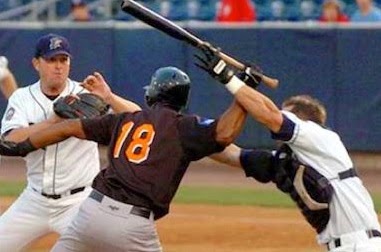
Matt Beech (L), Jose Offerman (M), Johnathan Nathan (R)  Photo credit: Christian Abraham
Nathans v. Offerman, 3:09-cv-00256-WWE, 922 F.Supp.2d 271, (D. Conn., 2013)

What happened?

Jose Offerman was an infielder who played for 15 years in the Major Leagues, last playing for the Mets in 2005.  At his peak, Offerman signed a free agent deal with the Red Sox in 1998 that paid him $26 million over 4 years.  Although Offerman was an All-Star in 1999, his offensive production started to wane in 2000 and he was eventually traded away near the end of the Boston contract.  By 2006, Offerman was playing for the Mets' AAA affiliate in Norfolk and, after hitting  just .238 in 97 games, was granted free agency at the conclusion of the season.  

Unable to find a Major League job for the 2007 season, he signed on to play for the Long Island Ducks in the independent Atlantic League, joining a team that included Pete Rose, Jr. and former Major League All-Stars Carl Everett and Edgardo Alfonso.  Offerman enjoyed a resurgent season feasting on minor league pitching, posting a .335/.425/.502 line with 8 home runs through 69 games.  

On August 14, 2007, Offerman was in the lead-off spot for the Ducks, who were visiting the Bridgeport Bluefish of Connecticut.  Offerman promptly hit Matt Beech's first pitch of the game over the wall for a home run.  Offerman then came to the plate again in the second inning.  After a swinging strike, Beech's next pitch plunked Offerman on his left calf.  Instead of taking first base, however, Offerman charged the mound with his bat in hand.

As Beech stood his ground, Bluefish catcher Johnathan Nathans chased Offerman towards the middle of the infield and was allegedly struck in the head by Offerman's bat.  Offerman was ejected from the game and arrested later that night on two counts of Assault in the Second Degree.  He was suspended by the league and never played for the Ducks again.  Offerman was placed on two years probation and the criminal charges were ultimately dismissed. 

Nathans, who had played as high as AA ball in the Red Sox organization several years earlier, tried to stay in the game but was ultimately removed from the game and taken for medical care.

In his lawsuit, Nathans claimed that Offerman and the Long Island Ducks were guilty of (1) assault and battery, (2) negligence, and (3) reckless assault and battery.  Nathans alleged a number of resulting injuries from the attack, including a concussion, post-concussion syndrome, vertigo, headaches, vestibular dysfunction, inner ear damage and post traumatic stress disorder, among others.
 
Motion for Summary Judgment

The Ducks filed a motion for summary judgment asking that the court dismiss them as a defendant because Offerman's conduct was outside of the scope and course of his employment with the team; Offerman could not be held responsible for the injuries because Nathans was a co-participant in a contact sport; and, that even if held liable for the acts of Offerman, the Ducks could not be held responsible for punitive damages.

With regard to the assertion that Offerman was not within the course and scope of his employment, the court denied the motion, holding that "[a] master does not escape liability merely because his servant loses his temper while he is conducting his master's business."  The court believed it was "not unexpected for a batter to charge the mound after being hit by a pitch."  While it was "unusual" for the batter to bring along the bat, but not unprecedented, this act was not such a clear-cut digression from his work duties that the court could dismiss the case.  They felt it was a better question for the jury to answer.

As to the co-participant theory, the court granted the motion as to the negligence counts because mere negligence was not enough under Connecticut law to create liability between co-participants in a team contact sport.  However, liability could be lie with reckless or intentional conduct; therefore, the motion was denied as to the assault and battery counts.

Finally, the court found that the Ducks could not be found responsible for any punitive damages assessed on the part of their employee Offerman.

Who won?

Johnathan Nathans.

This case proceeded to trial and the jury was tasked with determining whether Johnathan Nathans had proven that Jose Offerman committed an assault and/or committed a battery upon which damages could be awarded to Nathans.  Additionally, the jury was asked whether Offerman's conduct was committed within the course and scope of his employment with the ball club.

Ultimately, the jury found that Offerman had assaulted Nathans but that Nathans had not proven a battery.  They awarded Nathans a total of $940,000 in damages.

The jury additionally found that Offerman was not acting in the course and scope of his employment at the time of the occurrence and in doing so, exonerated the Long Island Ducks of any wrongdoing.

Amended judgment
What's next?

Both Nathans and Offerman have filed post-trial motions asking the court for a new trial.

Nathans believes the jury incorrectly found that Offerman was not in the course of his employment at the time of the incident and that the trial court failed to give the jury proper instructions on the agency relationship.

Offerman asks for a new trial due to the inconsistencies in the jury's findings and verdict.  He argues that because he was not found to be responsible for the battery, which requires actual physical contact, he should not be responsible for damages that clearly had to have resulted from being struck by the bat.  [Being found responsible for the assault would only require that Nathans was put in a reasonable fear of harm from an Offerman attack and no actual physical contact would be necessary to award damages.]  Also, Offerman asked that the court to find that he was acting in the course and scope of his employment, such that the Ducks would share in the responsibility of payment of the verdict.

Updates will be posted when the court rules on these post-trial notions.

What about Jonathan Nathans since the attack?

Nathans never returned to professional baseball and instead pursued a law degree.  He is currently a practicing attorney in Maine.

What about Jose Offerman since the attack?
    
Offerman played two more seasons in the Mexican League before retiring as a player.  As the manager in the Dominican Republic Winter League, Offerman got into a heated discussion with the umpires during a game on January 16, 2010.  He punched one of the umpires and as a result was banned from the league for life.


The lifetime ban was eventually overturned and he has since managed again in the Dominican winter league and for the Veracruz Red Eagles in the Mexican League.

Wednesday, September 3, 2014

New York Court Declines to Label Wiffle Ball Bat a Lethal Weapon

Vintage Wooden Wiffle Ball Bat - Photo Credit: www.wiffleballusa.com 
Schuh v. Hickis, 37 Misc.2d 477, 236 N.Y.S.2d 214 (N.Y.Sup., 1962)

What Happened?

Sandra Tasyn (14) was visiting relatives in New Hyde Park, New York on June 1, 1958.  She and her cousin went to the defendant Hickis' home, about a block away from her cousin's house, and began to play a Wiffle Ball game in his backyard.  

The plaintiff, Stephen Schuh (7), came over to the yard and joined in the game.  While Schuh was waiting for his turn to bat, Tasyn swung at the ball and the bat slipped from her hands, hitting Schuh in the face.  (Wiffle Ball bats were made of wood from 1955-1972!)  

Stephen Schuh's father sued on his son's behalf to recover for medical expenses and loss of services. Schuh claimed that Charles Hickis was responsible because he allowed the children to play in his yard and that Sandra Tasyn's parents should have followed her around and supervised her play.  

Both Hickis and the Tasyn's moved for summary judgement, asking the court to dismiss the case.

Who Won?

The court agreed with the defendants and granted summary judgment, dismissing the case.  The court also denied Schuh's motion to add Sandra Tasyn, who had since turned 18, as a defendant.

Why?
  
As to the Tasyn's, parents are not per se liable for the torts of their children, except under certain circumstances.  For example, if they were to have furnished Sandra with a gun, they could have been held liable for their own negligence in doing so.  In this case, however, the Tasyn's had nothing to do with the offending Wiffle bat and even if they did, "such ordinary instruments of play in the hands of a 14-year-old could scarcely be considered a lethal agency."

As to Hickis, the court found there was nothing wrong with the physical condition of the yard on which to predicate responsibility for this occurrence.  

Tuesday, August 26, 2014

Indiana Supreme Court Finds for RailCats but Declines to Adopt Baseball Rule in Fan's Foul Ball Injury Case

Gary Southshore RailCats Home Ballpark
Southshore Baseball, LLC v. Juanita DeJesus, No. 45S03-1308-CT-531 (Ind., 2014)

What Happened?

On May 23, 2009, Juanita DeJesus attended the Gary Southshore RailCat's opening day game at The U.S. Steel Steelyard in Gary, Indiana.  On this warm, clear night, the RailCats were set to battle their Northern League foes, the Fargo-Moorhead RedHawks.  Ms. DeJesus and her fiance attended the game, meeting their friend and her niece at their seats in section 111, which were just beyond the protective netting behind home plate along the first base line.  

Second baseman Carlo Cota, the second batter of the game, hit a pop-up foul ball back into the stands.  Ms. DeJesus saw Cota make contact with the ball but as she looked up to find it, the ball struck her in the face.  As a result, she sustained several fractured facial bones and was left with permanent blindness in her left eye.


Ms. DeJesus filed a lawsuit against the RailCats claiming that they "were negligent in failing to make [the] premises reasonably safe for [her], a business invitee."  Specifically, she claimed that the RailCats should have extended the netting further down the line to have protected her seat from foul balls.  She even hired an expert who opined that the netting should have protected all of the seating sections.

The RailCats countered that the netting was adequate and that plaintiff had not produced any evidence, other than the claims of their expert, that the netting was defective.  Additionally, the defendants argued that there was no evidence that plaintiff failed to appreciate the danger of foul balls entering the stands or that being struck by a foul ball was an unreasonable risk of harm.  Finally, they urged the Indiana Supreme Court to adopt the "Baseball Rule" in which the RailCats would have been absolved of liability for a foul ball injury like this because they provided screening behind home plate sufficient to meet the ordinary demand for those protected seats.

Based on these defenses, the defendants moved for summary judgment, asking the trial court to dismiss the plaintiff's case due to her inability to prove the negligence or premises liability claims.

Who Won?

Although the RailCats were not able to beat the RedHawks on that May 23rd evening, losing 3-2 in 10 innings, they ultimately prevailed in this case.

Initially, the trial court denied defendants' motion for summary judgment but allowed defendants to pursue an immediate appeal.

The Court of Appeals, however, reversed the decision of the trial court and returned the case with instructions to grant the defendants' summary judgment motion in its entirety.  They specifically adopted the majority rule that a baseball stadium operator has only the duty to screen the most dangerous areas behind home plate.

The case was thereafter accepted by the Supreme Court for review.  The Supreme Court declined to adopt the Baseball Rule but affirmed the ruling of the Court of Appeals having dismissed Ms. DeJesus' case.

Why?

The Court cited this passage from the 1911 case of Charles Carr v. State in which plaintiff had been convicted of playing baseball on Sunday, in violation of a Draconian Indiana law which prohibited "rioting, hunting, fishing, quarreling, at common labor or engaged in his usual avocation" on Sundays.  
That baseball has come to be the one great American outdoor game; that it is played during the summer season throughout the land by boy and youth and man, beginner, amateur, and professional, in country village, town, and city; that it is played out of doors in seasonable weather; that it engages the mind alike of the participant and the spectator in an entertaining way; that it trains the body to vigor and activity and to a degree the mind to alertness; that the playing of a game requires but a fraction of a half day; that it cannot be successfully played at night; that those who witness it find in it for the time a relief mentally and physically from the stress of the intense life we as a people lead - are facts known of all men, and of which the courts and Legislatures cannot be wholly ignorant.  Carr v. State, 175 Ind. 241, 93 N.E. 1071 (Ind., 1911).
Despite the inclusion of this romantic passage and an acknowledgement that over a dozen other states had adopted the Baseball Rule, the Court was not convinced that baseball was worthy of its own special rule of liability.  The Court ultimately concluded that the enactment of the Baseball Rule in Indiana was better left the judgment of the legislature, recognizing that Arizona, Colorado, Illinois and New Jersey had codified the Baseball Rule.

With regard to the premises liability claims, the Court held that the warnings regarding the potential danger of foul balls printed on the tickets, posted on signs and announced over the public address system were adequate such that the RailCats would have had no reason to believe that DeJesus "would not realize the danger or that she would not protect herself against it."  

As to the negligence claims made by plaintiff, the Court found that plaintiff was unable to establish that she had relied on the netting to protect her from the danger presented by foul balls.  Specifically, she had testified in her deposition that she had seen foul balls enter the stands before at RailCats games and even admitted that she knew that a foul ball could come her way while she was sitting in her seat that day.   

Thursday, August 21, 2014

Toronto Blue Jays Oppose Creighton University Trademark Application


Rogers Blue Jays Baseball Partnership v. Creighton University, In re Application Serial No. 86067719

The Toronto Blue Jays have filed a Notice of Opposition with the U.S. Trademark Trial and Appeal Board in an effort to prevent the approval of trademark protection for the new logo being offered on sports apparel by Omaha's Creighton University.  Creighton has filed for trademark protection for a stylized blue jay head design to be used on "Athletic apparel, namely, shirts, pants, jackets, footwear, hats and caps, [and] athletic uniforms."  This is the Creighton logo, from a t-shirt currently available on their athletic department web site.


For their part, the Toronto Blue Jays have claimed that the team has continually used very similar logo designs from well before the Creighton application date of September 18, 2013 as shown here:


As a result of the alleged similarity, the Toronto Blue Jays claim Creighton has caused confusion and deceived the public that the Creighton goods were approved or endorsed by Toronto's Major League Baseball team.  They further claim to be damaged by causing a likelihood of dilution "by blurring the distinctive quality" of the Toronto marks.  The Toronto Blue Jays request that the Creighton application be denied.

The basic analysis of trademark infringement is the "likelihood of confusion."  Accordingly, the Toronto Blue Jays do not need to show actual confusion.  The specific inquiries that the Trademark Trial and Appeal Board will make include: the similarity of the marks with respect to appearance and impression, the similarity of the goods or services, the similarity of "trade channels", the strength of the competing marks, actual confusion, length of time of concurrent use without actual confusion and the variety of goods with which each of the marks is used.  In re E.I. DuPont DeNemours & Co. (1973).    

The decision of the board will be posted after it has been issued.  What do you think is going to happen?

Tuesday, July 29, 2014

The Supreme Court of Missouri Declares that Getting Hit by a Hot Dog is Not an Inherent Risk of Attending a Royals Baseball Game


Coomer v. Kansas City Royals Baseball Corp., SC93214 (Mo., 2014)
Coomer v. Kansas City Royals Baseball Corp., WD73984, WD74040 (Mo. App. 2013)
Circuit Court of Jackson County, Missouri, 1016-CV04073

What happened?

The Royals mascot, Sluggerrr, is a large lion played by John Byron Shores.  Since 2000, Shores has been famous for launching hotdogs into the crowd from an air cannon and tossing them by hand in entertaining ways, including over his shoulder and behind his back. 

On September 8, 2009, John Coomer attended the Kansas City Royals and Detroit Tigers game at Kauffman Stadium with his father.  Instead of sitting in their ticketed seats, Mr. Coomer and his father found seats approximately six rows behind the dugout on the third base side. 

Mr. Shores performed the “Hotdog Launch” promotion between the third and fourth innings of this game and after finishing with the air gun, began manually tossing foil-wrapped hotdogs into the stands from his position atop the third base dugout.    

Mr. Shores attempted to throw a hotdog behind his back in the direction of Mr. Coomer, just as Mr. Coomer turned to look at the scoreboard.  The hotdog reportedly hit Mr. Coomer in the face with enough force to knock off his hat, but he did not report the incident to the Royals at that time.  He also attended the game the next day and noticed no issues with his vision.

Two days after the occurrence, Mr. Coomer first began to notice vision problems.  He was ultimately diagnosed with a detached retina and cataracts in his eye - allegedly as a result of the errant toss.  He underwent two surgeries and claimed a permanent vision loss in the eye, despite an artificial lens implant. 

The case was tried in front of a Jackson County jury in March, 2011.  The jury deliberated and returned its verdict on March 9, 2011.

Who won?

The Royals.  The jury found that Mr. Coomer was 100% at fault for the occurrence and awarded him no damages for his injuries.  

The appeal

Plaintiff appealed judgment on the verdict claiming that the court erred in instructing the jury on the various assumption of risk defenses claimed by the Royals.  The plaintiff specifically argued that a “mascot throwing hot dogs directly at [fans] is not an inherent or unavoidable risk of the game of baseball.”

The Royals countered that Mr. Coomer, who admittedly had been to 175 previous games at Royals Stadium and had previously seen the Hotdog Launch, assumed the risk of being hit by the hotdog because the promotion was a customary part of the game and Mr. Coomer consented to the risk by attending the game.

Who won the appeal?   

Mr. Coomer. 

The appellate court noted that everyone who attends a baseball game assumes the risk of being hit by a ball because the risk is inherent to the game; however, the court agreed with the plaintiff that the trial court erred in submitting the assumption of risk defense to the jury because, “the risks created by a mascot throwing promotional items do not arise from the inherent nature of a baseball game.”

The primary assumption of risk instruction given by the trial court informed the jury that this was a complete bar to recovery.  Because the primary assumption of risk instruction should not have been given, judgment was reversed.

Supreme Court

The Royals sought to have the case appealed to the Missouri Supreme Court.  The case was accepted and oral arguments proceeded on September 11, 2013

The Supreme Court agreed with the lower court, finding that the trial court erred in allowing the jury to determine whether being injured by the hotdog toss was an inherent risk of watching a Royals home game, instead finding that the judge should have decided the issue.  Specifically and importantly, "The risk of being injured by Sluggerrr's hotdog toss...is not an unavoidable part of watching the Royals play baseball."  

The Court reiterated that the Royals likely would not have been responsible for Mr. Coomer's injury if it had been caused by a foul ball or bat leaving the field and cited with approval prior decisions supporting the "Baseball Rule" as it was applied in Missouri.  They went so far as to declare that being injured by the hotdog toss was not even an inherent risk of the hotdog toss.  

What's Next for Mr. Coomer?    


The trial court's judgment for the Royals was vacated and remanded, meaning that the results of the first trial were voided and the case was returned to the trial court for another trial or, perhaps, a potential settlement.

Tuesday, July 22, 2014

Cubs File Lawsuit Against Unofficial Mascot Billy the Cub

Chicago Cubs Baseball Club, LLC v. Weier, et al., 14-cv-05507, Northern District of Illinois

Photograph of Billy the Cub, from Exhibit D of the Complaint

If you have been to Wrigley Field in the past several years, you may have encountered one of several large bears donning a Cubs helmet and wearing a #78 jersey wandering around outside the park and posing for pictures. Not to be confused with the Cubs new official mascot, Clark, Billy the Cub is actually a for-profit venture that has no affiliation with the team.

Clark, the Cubs official mascot introduced in 2014
Although the owner of the costumes has reportedly been rebuffed by the Cubs in his efforts to become the sanctioned mascot and has been the subject of cease and desist requests, the Billy the Cub costumers are still seen seeking tips around the neighborhood on game days. The Cubs have finally had enough, however, and it was likely this video showing the man inside the costume getting in a fistfight that was the tipping point in the Cubs initiating legal action.


Not surprisingly, the Cubs do not want to be associated with with these unsanctioned "mascots" and they allege in their complaint that the defendants "interact with Cubs fans by posing for photos or videos with the fans and engaging in other mascot-like activities (such as dancing with fans), and then seek to hustle those same fans for 'fees' or 'tips."  In addition to the explicit reference to the bar fight depicted in the YouTube video shown above, the Cubs further allege that the defendants have made profane and derogatory remarks to fans, including racial slurs, often in relation to the amount of the tip.

The Cubs specifically complain of trademark infringement, trademark dilution and violations of the Illinois Uniform Deceptive Trade Practices Act.  As for damages, they seek the permanent injunction of further Billy the Cub activities, a disgorgement of all profits, the delivery of costumes for destruction, punitive damages and attorneys fees.

The Lanham Act states in pertinent part:
(a) (1) Any person who, on or in connection with any goods or services,...uses in commerce any word, term, name, symbol, or device, or any combination thereof, or any false designation of origin, false or misleading description of fact, or false or misleading representation of fact, which—
(A) is likely to cause confusion, or to cause mistake, or to deceive as to the affiliation,
connection, or association of such person with another person
, or as to the origin,
sponsorship, or approval of his or her goods, services, or commercial activities by another
person...
shall be liable in a civil action by any person who believes that he or she is or is likely to be
damaged by such act.  §43 (15 U.S.C. §1125).
It appears that the Cubs are on good legal footing here and at the very least, the threat of having to reimburse the Cubs for their legal fees would seem to be a pretty strong incentive for the defendants to discontinue their Billy the Cub operations, even if they have insurance coverage that will provide them with a defense.

It will be interesting to see if they have as much fight in them in the defense of this lawsuit as was seen at the bar.  

Tuesday, February 11, 2014

Albert Pujols Drops PED Allegation Lawsuit Against Jack Clark

Albert Pujols has reportedly agreed to dismiss the 2013 defamation lawsuit he filed against former slugger Jack Clark in advance of a hearing on Clark's motion to dismiss scheduled for February 20, 2014.  Terms of the settlement, if any, have not been disclosed. 

Jack Clark has issued the following statement:
"I would like to address Albert Pujols' pending defamation lawsuit and re-confirm that I have no knowledge whatsoever that Mr. Pujols has ever used illegal or banned PEDs. I publicly retract my statements that Albert Pujols used such substances. During a heated discussion on air, I misspoke and for that I sincerely apologize."
And Pujols has responded, "I have accepted Jack Clark's retraction and apology to resolve my lawsuit against him and clear my name."


Monday, December 23, 2013

Lawyer Tony LaRussa Inducted into the Baseball Hall of Fame

Most people know Tony LaRussa as a Major League manager.  It is also widely known that he got his law degree, anticipating that his life in baseball was to be short-lived. 

What is not as well-known is Tony LaRussa, the Chicago Cub.  LaRussa made his major league debut as an 18 year old in 1963 with the then Kansas City Athletics.  He played second base and hit .250 in 53 plate appearances.  He showed a keen eye and posted an on base percentage nearly one hundred points higher at .346.  It took LaRussa another four seasons, however, to work his way back to the major league club, appearing in 13 games for the Oakland Athletics from 1968-1969. 

In 1970, Tony LaRussa was able to crack the lineup more regularly, appearing in 52 games and hitting .198 in 123 plate appearances.  He again showed a good eye, posting an on base percentage over one hundred points higher at .301.  After going hitless in 8 at bats for the 1971 A’s, LaRussa’s contract was purchased by Atlanta, where he hit a robust .286 and had a sparkling .375 on base average in 8 plate appearances with the Braves.  

LaRussa played in the Braves’ system in 1972 but did not make an appearance with the big club in Atlanta that season.  On October 20, 1972 the Braves traded him to the Chicago Cubs in exchange for right-handed pitcher Tom Phoebus, who had gone 3-3 with 6 saves and a 3.78 ERA in 37 appearances with the Cubs.

In 1973, LaRussa made the team out of spring training and was on the bench for the April 6th contest as the Expos faced the Cubs in front of 40,273 at Wrigley Field.  The Expos struck first, scoring 2 runs off of Fergie Jenkins in the top of the 1st inning.  The Cubs scored a run in the bottom of the 1st off of Mike Torrez and the score remained 2-1 as the Cubs came to bat in the bottom of the 9th. 

Cubs first baseman Joe Pepitone led off the inning with a single to centerfield, despite a five-man infield, and Cleo James was called to run for him.  Ron Santo then reached on an error on a ball hit to Expos second baseman Ron Hunt.  Cubs manager Whitey Lockman turned to LaRussa and pointed a finger in his direction.  “Run for Santo” was all he said.  Tony LaRussa grabbed his helmet and trotted out to first base to spell Santo.

Glenn Beckert drew a base on balls and the Cubs were in business with the bases loaded and nobody out.  Randy Hundley walked and Jones scored to tie the game at 2-2.  But Don Kessinger promptly fouled out and Jim Hickman followed with a strikeout. 

The Cubs were down to their final out and Rick Monday came to the plate, hoping to break the tie and avoid extra innings.  Tony LaRussa danced off of third.  Monday worked the count against fireballer Mike Marshall and eventually coaxed a walk!  LaRussa jogged home and triumphantly stomped on home plate, having scored the winning run in his Cubs debut.

And there you have the entirety of Tony LaRussa’s career with the Cubs.  He never appeared in another major league game for the Cubs after he scored the winning run on Opening Day, 1973.  LaRussa was sent down to the Cubs’ AA affiliate in Wichita and put together a nice season, hitting .314/.403./.393 with 5 home runs and 75 RBIs in 106 games for the Aeros.

After another four seasons in the minors, LaRussa retired as a player at the end of the 1977 season, never having reached the major leagues again.  The very next year, he was hired to manage the White Sox AA team in Knoxville.  By August, 1979 he was called upon to manage the Chicago White Sox when his 1973 Cubs teammate Don Kessinger resigned from the post. 

LaRussa managed consecutively in the major leagues through his retirement in 2011.  He is just one of four men listed on the Cubs all-time roster as a pinch runner and only one of two, the other being Mel Kerr, to have scored a run in his only pinch running appearance.

He finished his managerial career third on the all-time list with 2851 wins and led the 1989 A’s and 2006 and 2011 Cardinals to World Series titles.  He is now a Hall of Famer, inducted with fellow managers Bobby Cox and Joe Torre

Sunday, December 15, 2013

Comedian Danny Thomas’ Investment Group Fails in Bid to Buy Chicago White Sox

Epton v. CBC Corp., 48 Ill.App.2d 274, 197 N.E.2d 727 (Ill. App. 1 Dist., 1964)

What happened?
 

In early April 1961, the investment group with a controlling interest in the Chicago White Sox offered to sell its share to a consortium organized by Chicago attorney Bernard Epton that included well-known comedian Danny Thomas. The agreed upon sale price was $4.8 million (about $37.5 million today.)

The White Sox stock, comprising a 54% share, was owned by CBC Corporation, controlled by Bill Veeck, Hall of Famer Hank Greenberg and Arthur Allyn, Jr. The group had purchased this share on March 10, 1959 from White Sox founder Charles Comiskey’s daughter, Dorothy, for $2.7 million (about $21.8 million today.)

Upon the sale to CBC, the White Sox enjoyed immediate success and captured the 1959 American League pennant. After falling to the Los Angeles Dodgers in the World Series; however, the White Sox finished 10 games back in 1960. By early 1961, the Bill Veeck group saw an opportunity to make a quick, handsome profit and agreed to sell their 54% interest in the American Baseball League Club of Chicago to the Danny Thomas group.

On May 31, 1961, a handshake deal was made with the Thomas group having a one-week option for $1000 to purchase the shares of stock for the agreed upon price. At the conclusion of this meeting, Veeck reportedly told Epton, "O.K., Bernie, *** we have a deal. I am glad that it’s taken care of. I know you will do a good job." Greenburg and Allyn are also alleged to have shaken hands with Epton and congratulated him on the deal. The written option agreement had not been signed, however.


As agreed, plaintiff delivered the check for $1000 to the seller’s attorney on the morning of June 2, 1961. That afternoon, however, Epton visited Allyn’s office and was told that Greenberg was being difficult. Allyn assured Epton that they would get the option agreement signed so that the sale could be formally announced on June 5, 1961. For unknown reasons, however, Hank Greenberg was having second thoughts.

On June 3, 1961, Epton offered a certified check in the amount of $100,000 to show their group’s good faith and ability to perform. Veeck refused the check, telling Epton that it was not necessary.
Bernard Epton with Certified Check
On June 5, 1961, CBC returned the $1000 check that they had accepted but not deposited, informing the Thomas group that Greenberg was not willing to sign the option agreement and that the CBC group was not going to be able to sell the stock to them.

As a result of the deal having fallen through, Epton filed suit seeking that the court compel CBC to sell them the team under the terms of the option agreement or alternatively, award them damages in the amount of $700,000 (about $5.47 million today), claiming that the stock they agreed to purchase for $4.8 million was actually worth $5.5 million.

The option agreement at issue provided that the Thomas group was to give written notice of their intent to exercise the purchase option and deliver a check in the amount of $99,000 to CBC. The Thomas group had not done either but claimed that their oral notice was sufficient and that they had substantially complied by offering the $100,000 check that Bill Veeck said was not necessary.

So who won?

The court ruled in favor of the CBC group, refusing to force the sale or award any monetary damages to the Thomas group.

Why?

The court found that even though Epton was on notice that Greenberg was refusing to go along with the option, "plaintiff still did not give written notice or pay the required $99,000; rather, he insisted that defendants sign the option agreement, thereby evidencing his uncertainty as to whether there was in fact any binding agreement." Accordingly, the court affirmed the lower court’s dismissal of Epton’s lawsuit.

What happened after this lawsuit was decided?
 
Interestingly, the stock owned by Veeck and Greenberg was sold to Arthur Allyn, Jr. and his brother, John Allyn and they owned the team together until John bought out Arthur in 1969. In 1975 John Allyn sold the team back to Bill Veeck.

Bernard Epton served in the Illinois House of Representatives from 1969 through 1983. He was unsuccessful in his 1983 bid for mayor of Chicago, losing a close race to Harold Washington.

Danny Thomas founded the St. Jude Children's Research Hospital in 1962.  It may never be known if the White Sox deal falling through sped up his efforts to bring the children's hospital to fruition, but Danny Thomas' vision has certainly been responsible for saving the lives of thousands of children since its inception. 

Saturday, December 14, 2013

Over Fifty Years Before Jackie Robinson Broke Major League Baseball’s Color Barrier, an Integrated Minor League Team Battled for the Rights to Future Hall of Fame Black Ballplayer Frank Grant

Harrisburg Base-Ball Club v. Athletic Association, 1890 WL 2997, Pa.Com.Pl. (1890)

Who was Frank Grant?
The plaintiff in this case, better known as the Cuban Giants, was admitted to Eastern Interstate League as the representative from York, Pennsylvania and played as the Monarchs.  The manager of the defendant Harrisburg Ponies, James Farrington, was none too pleased that the talented Giants were welcomed into the league and countered by luring second baseman Frank Grant and catcher Clarence Williams to sign on with the Ponies, despite the fact that each had already signed contracts to play for the Giants/Monarchs for the 1890 season.
Grant was held in such high regard that he received a hero’s welcome in Harrisburg and was nicknamed “The Colored Dunlap” (an obviously insensitive moniker nowadays) due to his favorable comparisons to white second baseman Fred Dunlap.
According to the Harrisburg Morning Patriot, Grant was the “most famous colored ballplayer in the business” and “when he appeared on the field a great shout went up from the immense crowd to receive him, in recognition of which he politely raised his cap.”
What was the basis for the lawsuit?
The Giants claimed that the loss of Grant, one of their “most expert players” would cause irreparable harm to their profitability.  Moreover, the Giants claimed that they had expended great sums of money to erect “buildings, fences and accommodations for the public” with the expectation that Grant, “a player of great reputation,” would draw a substantially larger paid attendance.  They asked the court to issue an injunction to prevent Grant from playing for the Harrisburg Ponies in 1890.  Importantly, however, the Giants could not ask the court to compel Grant to play for them in 1890 because such a remedy was not available at law.
So who won?
The court ruled in favor of the Ponies and Frank Grant was allowed to play the 1890 season for Harrisburg.
Why?
The court found that because they did not have the power to force Grant to play for the Giants in 1890, Grant’s playing for the Ponies was not the direct cause of the damages to the Giants.  In other words, the Harrisburg Ponies were not at fault because the Giants would have sustained the same claimed losses even if Grant had played a team other than the ponies.
Additionally, the court found that Grant’s contract with the Giants was not fully enforceable because it lacked mutuality, in that only the Giants had the right to compel specific performance.  The provision that the court singled out gave the club the right to cancel the contract “at any time” if it appeared that Grant was “not fulfilling his agreements to the best of his ability.”
What happened after the case was decided?
Grant enjoyed a productive season for the Ponies during their time in the Eastern Interstate League, hitting .333, slugging .488 and stealing 22 bases in 59 games.  In the middle of July, an opportunity arose for the Ponies to join a higher minor league when the Jersey City Jerseys of the Atlantic Association folded. 

The problem for the Ponies was that the American Association did not have any black players.  Teams such as the Washington Senators and Baltimore Orioles initially refused to play the Ponies if Grant was in the lineup.  Regardless, Harrisburg was admitted and took over Jersey City’s record. 
Despite the prejudice Grant faced on and off the field, he hit .332 with 13 doubles in 47 American Association games with the Ponies.  In 2006, Frank Grant was inducted into the Hall of Fame by the Negro League Committee.

Tuesday, December 10, 2013

James E. Bennett - Inventor of Baseball's Most Ridiculous Patented Equipment

What is a patent?

Long ago, governments recognized that protecting inventors’ efforts was essential to encourage technological advancement but realized that limiting the time in which an inventor had the exclusive right to market their invention served the greater good by preventing the inventor from controlling a useful product forever.  Patents were first granted in Europe in the late 1400s and the patent system was first enacted in the United States in 1790.  To date, there have been thousands baseball-related patents issued covering everything from game equipment to methods of compressing game broadcasts. 

In the United States, a patent is an intellectual property right granted by the government to an inventor that “excludes others from making, using, offering for sale, or selling the invention throughout the United States or importing the invention into the United States” for a limited time in exchange for public disclosure of the invention when the patent is granted.  Currently, a utility patent is enforceable for 20 years from the date on which the application was submitted, assuming that periodic maintenance fees are paid as scheduled.

What can be patented?

A utility patent will be granted for a machine, process, article of manufacture, composition of matter (or any improvement to an existing machine, process, article of manufacture, composition of matter) as long as it is “new, nonobvious and useful.”  There are certain things that cannot be patented, however, such as laws of nature, abstract ideas and inventions that are morally offensive or “not useful.”

The “non useful” component is somewhat interesting in that the patent examiner is charged only with making a decision whether an invention will function as expected and otherwise has a “useful purpose.”  As you will see below, “useful” does not always mean that the invention will be marketable.

So how did James Bennett hope to change baseball?

While it is not clear whether inventor James E. Bennett of Momence, Illinois is the same James Bennett who played for the Sharon Ironmongers in the 1895 Iron and Oil League, it seems clear that he did not exert any forethought as to whether his inventions would be practical when used under baseball game conditions.  Either that or he just really hated catching a ball with the existing baseball glove technology available at the turn of the 20th Century. 

By the early 1900s, baseball gloves had undergone constant improvement.  Starting with George Rawlings in 1885, (Pat. No. 325,968) protective gloves were becoming more acceptable to protect fielders’ hands.  In 1891, Harry Decker added a thick pad to the front of the glove (Pat. No. 450,355) and Bob Reach added an inflatable chamber (Pat. No. 450,717).  By 1895 Elroy Rogers had designed the classic “pillow-style” catcher’s mitt (Pat. No. 528,343) that would be used with little change until Randy Hundley pioneered the one-handed catching technique in the 1960s using a hinged catcher’s mitt.  

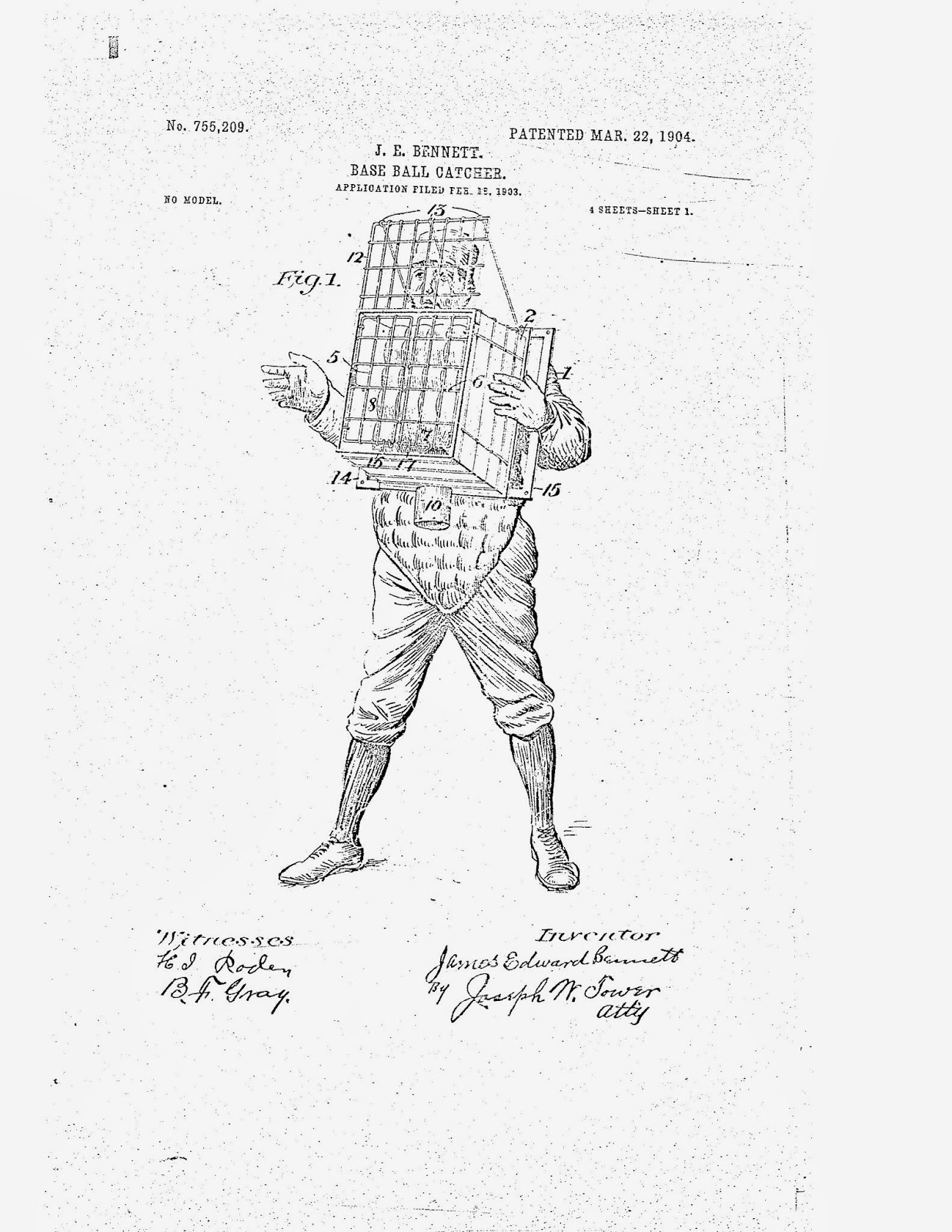
Regardless of the existence of the baseball glove technology in use at the time, James Bennett tried to think outside the box by eliminating the catcher’s mitt all together and, instead, attaching that box to the catcher.  Here is 1904’s "Base Ball Catcher" in all of its ill-conceived glory:

Front View
Side View
Bennett apparently envisioned the catcher squatting behind home plate acting as a passive target for the pitcher’s offerings and designed this contraption to accept the pitched ball into the cage such that it would strike the padding and drop through a chute into the catcher’s hand so it could be returned to the mound.  As you can see, however, the device would have significant shortcomings should the catcher have to attempt to throw out a would-be base stealer, be required to catch the ball for a play at the plate, attempt to block a wild pitch or especially to field his position on a ball put in play in front of the plate.   
  
But Bennett was not finished yet! In 1905, he patented a two-handed "Base Ball Glove" with an oversized pocket to trap the ball:

Front and Back View
Bennett claims that this poorly imagined glove is easy to use because the fingers on the player’s throwing hand were specially designed to “permit the easy and quick removal of that hand to grasp and throw the ball.”  Just as with the "Base Ball Catcher," however, this design does not offer the player much in the way of a catching radius.   

So what happened to James E. Bennett’s inventions?

As of 1918, he was still looking for investors, according to this advertisement he placed in the August and October issues of “Forest and Stream” magazine.

Friday, November 22, 2013

Houston Astros Ownership Files Fraud Lawsuit against Drayton McLane over Botched TV Deal

Houston Baseball Partners, LLC v. McLane Champions, et al., No. 201370769, Harris County, Texas

The wrangling over future broadcasts of Houston Astros games has finally come to blows as the Houston Baseball Partners, LLC ownership group, led by Jim Crane, has filed a lawsuit in Harris County, Texas alleging misrepresentation and fraud.  Specifically, the petition alleges that the Houston Regional Sports Network, of which plaintiff purchased a 40 percent stake, was fraudulently overvalued and that the subscription rates previously being sold by defendants were rejected by Time Warner, Direct TV and AT&T. 
           
“Ultimately, fans of the Houston Astros have been injured because Defendants’ misrepresentations leave plaintiff with an impossible choice: either accept the broken network as is, and deprive thousands of fans the ability to watch Houston Astros games on their televisions, or distribute the games at market rates and take massive losses out of the Houston Astros player payroll – thereby dooming the franchise for years to come”

The Astros had formed the network in 2003, in conjunction with the Houston Rockets ownership, and Comcast later purchased an equity stake in the network in 2010.  Comcast agreed to pay certain monthly fees based on the number of subscribers in a given month for each of several distinct geographic zones. 

Plaintiff claims that Comcast eventually agreed to an “inflated” Zone 1 base rate; however, Comcast retained a “most favored nation” right such that they could reduce their rates if affiliate distributors were not willing to contract at the premium Zone 1 rate.  These “inflated” rates were thereafter incorporated into the Comcast business plan that plaintiff relied upon in negotiating the purchase of the ball club and broadcast network shares in 2011.

In order to prove their case, Houston Baseball Partners will need to prove that the (1) inflated Zone 1 base rates overstated the projected profitability and ultimate value of the Astros’ stake in the network, (2) that these representations were materially false and misleading when they were made, (3) the defendants knew or should have known that the representations were false and misleading, (4) that the false or misleading representations were made with the intent of inducing plaintiff to execute the purchase agreement, (5) that plaintiff relied on these misrepresentations to their detriment, and (6) that plaintiff suffered damages as a result.

Fraud is difficult to prove and initially, it would appear that plaintiff will have some difficulty establishing that the inflated rates were misleading if they were being honored at the time of the purchase.  Presumably, the most favored nation status would have been examined during the due diligence process and the risks that accompanied such a provision would likely have been accounted for in the purchase price.

What is not clear at this point is the correlation between the Astros’ on field performance and the number of subscribers that pay to access the broadcast, especially in light of the dismal performance of the team in 2013. 


Wednesday, November 13, 2013

Fan Injured in Promotional Horse Race Loses in Lawsuit Against Atlantic League Ball Club

Duncan v. Somerset Patriots Baseball Club, No. A-4279-08T3 (N.J. Super., 2010)

What Happened?

The Somerset Patriots are an independent minor league baseball team established in 1998 and based in Bridgewater, New Jersey.  The Patriots have enjoyed great success, winning the Atlantic League championship in 2001, 2003, 2005, 2008 and 2009 under the guidance of manager and former star reliever Sparky Lyle.  (In fact, the Patriots’ mustachioed mascot, Sparkee, was named after Lyle.)

Daniel Duncan attended the Patriots home game on August 5, 2006, a team whose roster featured the nephews of Hall of Famers Roberto Clemente (Edgard Clemente) and Ryne Sandberg (Jared Sandberg.)  

Duncan entered a random drawing to participate in several promotional events during the game and was selected to take part in the “Monmouth Park Horse Race.”  For this event, sponsored by the famous ocean-side racetrack of the same name, Duncan and a partner were given a horse head to carry (not the Godfather kind) and a bandanna to tie their legs together.  The race, itself, was to take place on the field, starting at home plate and ending at first base.

As Duncan went to take his first step, however, he lost his balance and fell, injuring his knee.  He claimed initially that he slipped on wet grass and did not allege any other defect that would have caused him to fall; however, he later testified at his deposition that he did not actually notice whether the grass was wet.  All of the other eyewitnesses testified the grass was dry.

The trial court dismissed the case, finding that the Patriots were not required to warn Duncan regarding the risks inherent in the three-legged race and that there was no evidence that the field was defective or had been improperly maintained.    

The Appeal

Plaintiff appealed claiming that there was a question of fact as to whether the field was defective and whether the Patriots should have warned him about the dangers he might encounter while taking part in the promotional race.

Who Won the Appeal?

The Somerset Patriots.  The appellate court affirmed the trial court’s dismissal of the injury lawsuit.

Why?

The reviewing court found that Duncan was aware of the hazards inherent in a three-legged race, having just participated in one with his son at a Boy Scout camp-out.  Furthermore they stated that, “walking and running on grass is a common experience, and the risk of doing so with any particular kind of footwear is known equally by the participant and the property owner.”

They felt further that the ball club could have provided warnings but this was balanced by the fact that Duncan voluntarily agreed to compete in the race.  Ultimately, the court held that the Patriots had no duty to warn plaintiff about the potential risks involved in the three-legged race.