Showing posts with label Injury - Players. Show all posts

Tuesday, September 9, 2014

Jose Offerman Ordered to Pay $940,000 to Catcher John Nathans for On-Field Assault with Bat

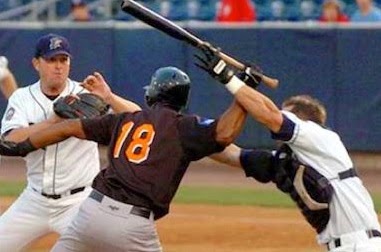
Matt Beech (L), Jose Offerman (M), Johnathan Nathan (R)  Photo credit: Christian Abraham
Nathans v. Offerman, 3:09-cv-00256-WWE, 922 F.Supp.2d 271, (D. Conn., 2013)

What happened?

Jose Offerman was an infielder who played for 15 years in the Major Leagues, last playing for the Mets in 2005.  At his peak, Offerman signed a free agent deal with the Red Sox in 1998 that paid him $26 million over 4 years.  Although Offerman was an All-Star in 1999, his offensive production started to wane in 2000 and he was eventually traded away near the end of the Boston contract.  By 2006, Offerman was playing for the Mets' AAA affiliate in Norfolk and, after hitting  just .238 in 97 games, was granted free agency at the conclusion of the season.  

Unable to find a Major League job for the 2007 season, he signed on to play for the Long Island Ducks in the independent Atlantic League, joining a team that included Pete Rose, Jr. and former Major League All-Stars Carl Everett and Edgardo Alfonso.  Offerman enjoyed a resurgent season feasting on minor league pitching, posting a .335/.425/.502 line with 8 home runs through 69 games.  

On August 14, 2007, Offerman was in the lead-off spot for the Ducks, who were visiting the Bridgeport Bluefish of Connecticut.  Offerman promptly hit Matt Beech's first pitch of the game over the wall for a home run.  Offerman then came to the plate again in the second inning.  After a swinging strike, Beech's next pitch plunked Offerman on his left calf.  Instead of taking first base, however, Offerman charged the mound with his bat in hand.

As Beech stood his ground, Bluefish catcher Johnathan Nathans chased Offerman towards the middle of the infield and was allegedly struck in the head by Offerman's bat.  Offerman was ejected from the game and arrested later that night on two counts of Assault in the Second Degree.  He was suspended by the league and never played for the Ducks again.  Offerman was placed on two years probation and the criminal charges were ultimately dismissed. 

Nathans, who had played as high as AA ball in the Red Sox organization several years earlier, tried to stay in the game but was ultimately removed from the game and taken for medical care.

In his lawsuit, Nathans claimed that Offerman and the Long Island Ducks were guilty of (1) assault and battery, (2) negligence, and (3) reckless assault and battery.  Nathans alleged a number of resulting injuries from the attack, including a concussion, post-concussion syndrome, vertigo, headaches, vestibular dysfunction, inner ear damage and post traumatic stress disorder, among others.
 
Motion for Summary Judgment

The Ducks filed a motion for summary judgment asking that the court dismiss them as a defendant because Offerman's conduct was outside of the scope and course of his employment with the team; Offerman could not be held responsible for the injuries because Nathans was a co-participant in a contact sport; and, that even if held liable for the acts of Offerman, the Ducks could not be held responsible for punitive damages.

With regard to the assertion that Offerman was not within the course and scope of his employment, the court denied the motion, holding that "[a] master does not escape liability merely because his servant loses his temper while he is conducting his master's business."  The court believed it was "not unexpected for a batter to charge the mound after being hit by a pitch."  While it was "unusual" for the batter to bring along the bat, but not unprecedented, this act was not such a clear-cut digression from his work duties that the court could dismiss the case.  They felt it was a better question for the jury to answer.

As to the co-participant theory, the court granted the motion as to the negligence counts because mere negligence was not enough under Connecticut law to create liability between co-participants in a team contact sport.  However, liability could be lie with reckless or intentional conduct; therefore, the motion was denied as to the assault and battery counts.

Finally, the court found that the Ducks could not be found responsible for any punitive damages assessed on the part of their employee Offerman.

Who won?

Johnathan Nathans.

This case proceeded to trial and the jury was tasked with determining whether Johnathan Nathans had proven that Jose Offerman committed an assault and/or committed a battery upon which damages could be awarded to Nathans.  Additionally, the jury was asked whether Offerman's conduct was committed within the course and scope of his employment with the ball club.

Ultimately, the jury found that Offerman had assaulted Nathans but that Nathans had not proven a battery.  They awarded Nathans a total of $940,000 in damages.

The jury additionally found that Offerman was not acting in the course and scope of his employment at the time of the occurrence and in doing so, exonerated the Long Island Ducks of any wrongdoing.

Amended judgment
What's next?

Both Nathans and Offerman have filed post-trial motions asking the court for a new trial.

Nathans believes the jury incorrectly found that Offerman was not in the course of his employment at the time of the incident and that the trial court failed to give the jury proper instructions on the agency relationship.

Offerman asks for a new trial due to the inconsistencies in the jury's findings and verdict.  He argues that because he was not found to be responsible for the battery, which requires actual physical contact, he should not be responsible for damages that clearly had to have resulted from being struck by the bat.  [Being found responsible for the assault would only require that Nathans was put in a reasonable fear of harm from an Offerman attack and no actual physical contact would be necessary to award damages.]  Also, Offerman asked that the court to find that he was acting in the course and scope of his employment, such that the Ducks would share in the responsibility of payment of the verdict.

Updates will be posted when the court rules on these post-trial notions.

What about Jonathan Nathans since the attack?

Nathans never returned to professional baseball and instead pursued a law degree.  He is currently a practicing attorney in Maine.

What about Jose Offerman since the attack?
    
Offerman played two more seasons in the Mexican League before retiring as a player.  As the manager in the Dominican Republic Winter League, Offerman got into a heated discussion with the umpires during a game on January 16, 2010.  He punched one of the umpires and as a result was banned from the league for life.


The lifetime ban was eventually overturned and he has since managed again in the Dominican winter league and for the Veracruz Red Eagles in the Mexican League.

Wednesday, September 3, 2014

New York Court Declines to Label Wiffle Ball Bat a Lethal Weapon

Vintage Wooden Wiffle Ball Bat - Photo Credit: www.wiffleballusa.com 
Schuh v. Hickis, 37 Misc.2d 477, 236 N.Y.S.2d 214 (N.Y.Sup., 1962)

What Happened?

Sandra Tasyn (14) was visiting relatives in New Hyde Park, New York on June 1, 1958.  She and her cousin went to the defendant Hickis' home, about a block away from her cousin's house, and began to play a Wiffle Ball game in his backyard.  

The plaintiff, Stephen Schuh (7), came over to the yard and joined in the game.  While Schuh was waiting for his turn to bat, Tasyn swung at the ball and the bat slipped from her hands, hitting Schuh in the face.  (Wiffle Ball bats were made of wood from 1955-1972!)  

Stephen Schuh's father sued on his son's behalf to recover for medical expenses and loss of services. Schuh claimed that Charles Hickis was responsible because he allowed the children to play in his yard and that Sandra Tasyn's parents should have followed her around and supervised her play.  

Both Hickis and the Tasyn's moved for summary judgement, asking the court to dismiss the case.

Who Won?

The court agreed with the defendants and granted summary judgment, dismissing the case.  The court also denied Schuh's motion to add Sandra Tasyn, who had since turned 18, as a defendant.

Why?
  
As to the Tasyn's, parents are not per se liable for the torts of their children, except under certain circumstances.  For example, if they were to have furnished Sandra with a gun, they could have been held liable for their own negligence in doing so.  In this case, however, the Tasyn's had nothing to do with the offending Wiffle bat and even if they did, "such ordinary instruments of play in the hands of a 14-year-old could scarcely be considered a lethal agency."

As to Hickis, the court found there was nothing wrong with the physical condition of the yard on which to predicate responsibility for this occurrence.  

Thursday, October 24, 2013

Dodgers Catcher John Roseboro Sues Juan Marichal and Rawlings for On-Field Injuries in Separate Occurrences

Roseboro v. Rawlings Mfg. Co., 79 Cal. Rptr. 567, 275 Cal.App.2d 43 (Cal. App. 2 Dist., 1969)


John Roseboro was the man who assumed the starting catcher’s role for the new Los Angeles Dodgers after Roy Campanella was paralyzed in a single-car accident before the start of the 1958 season.  Throughout his 11 years with the Dodgers, Roseboro won three World Series rings, two Gold Glove Awards and was named to several All-Star squads.  For a lot of people, however, Roseboro might be best remembered as the player that Hall of Fame pitcher Juan Marichal attacked during an August 22, 1965 game against the San Francisco Giants. 

While at bat, Marichal was reportedly angered by one of Roseboro’s throws back to Sandy Koufax coming too close to his head (or grazing his ear) and he snapped, swinging his bat wildly at Roseboro in retaliation.  Marichal reportedly struck him several times, including a blow to the head that resulted in a bloody gash.  The incident can be viewed on YouTube here.


Following the attack, Marichal issued a statement, “First of all, I want to apologize for hitting Roseboro with my bat. I am sorry I did that. But he was coming toward me, with his mask in his hand, and I was afraid he was going to hit me with his mask, so I swung my bat. If he had only said something, I would not have swung. I hit him once, and I am sorry.”  He was suspended for eight games by National League president Warren Giles, missing two starts, and fined $1750 (approximately $12,900 today.)  

Later in the season, Roseboro filed a lawsuit against Marichal for the attack, seeking $110,000 (approximately $815,000 today) in damages - nearly twice the amount of Marichal’s $60,000 salary for the 1965 season.  The case later settled for $7500 (approximately $55,000 today) and Roseboro eventually forgave Marichal publicly. 

This was not the first time that Roseboro had suffered an injury on the playing field that resulted in a lawsuit, however.

What happened that made John Roseboro sue Rawlings?

Having caught the entire first game, Roseboro was behind the plate for the second game of the Sunday doubleheader on April 29, 1962 at Dodgers Stadium against the Pittsburgh Pirates.  A Joe Moeller pitch was fouled off by the batter, breaking a weld at the top of Roseboro’s mask.  The ball entered the mask and struck Roseboro above his right eye.  He was dazed following the occurrence and was taken to the hospital, where he was kept overnight for observation.

Roseboro returned to the lineup on May 10, 1962 and was able to play the remainder of the season, although he claimed to have “bad headaches” that plagued him through 1963 or early 1964.     

The mask that Roseboro was using at the time of the occurrence was a new, lighter weight mask that had been developed by the defendant Rawlings.  Roseboro had used this particular mask at the end of the 1961 season, during spring training in 1962 and in all of the 20 games that Roseboro had played in 1962.  He indicated that in that time, the mask had acquired some typical dents but he inspected it before each game and found no apparent defects.

The employee who was in charge of quality control for Rawling’s products inspected the mask and found that had a different “contour” and was in a different condition than it was when it left the factory.  He claimed there was nothing Rawling’s could do to control the mask after it was obtained by a player and that it had “taken sufficient beating to be much less safe than when it left [Rawling’s] control.”

The employee who gave the mask to Roseboro also testified that the mask was “well used” and “pretty well beat up to stay in use” due to its flattened out appearance.

Who won?

John Roseboro.  Despite the testimony from the Rawlings employees, Roseboro was awarded $20,000 in damages (approximately $125,000 today) for his injuries. 

The victory was short lived, however.  The trial court granted the defendants’ motion for a new trial on the basis that the evidence was insufficient to support the verdict.

The appeal

Roseboro’s claim against Rawlings was on the basis of strict liability.  In order to recover under this theory, it was Roseboro’s burden to show that the subject catcher’s mask was defective at the time it was given to him. 

Rawlings argued that Roseboro’s claim was based on the “simple fact that the mask broke while he was using it in the manner for which it was intended to be used, and nothing more” and that he had no proof that the mask was defective at the time it was delivered. 

Who won the appeal?

Rawlings.  The appellate court agreed with the trial court that Roseboro did not have any evidence that the mask was defective at the time it was given to him.  Therefore, Roseboro was unable to prove a case under the theory of strict liability.

Thursday, October 17, 2013

Roberto Clemente’s Widow Sues F.A.A. Following Fatal Plane Crash

Clemente v. United States, 567 F.2d 1140 (C.A.1 (Puerto Rico), 1977) cert. denied, 435 U.S. 1006, 98 S.Ct. 1876, 56 L.Ed.2d 388 (1978)
Clemente v. United States, 422 F.Supp. 564 (D.P.R., 1976)

The Fatal Crash

Roberto Clemente was both a remarkable ballplayer and genuine folk hero.  As an outfielder for the Pittsburgh Pirates, Clemente was a perennial All-Star and Gold Glove recipient.  He won four batting titles, was the National League’s MVP in 1966 and the World Series MVP in 1971. 


On September 30, 1972, Clemente stroked a double off of Mets pitcher Jon Matlack to reach the 3000 hit milestone in his final regular season at bat.  After closing out the 1972 season with a playoff series loss to the Cincinnati Reds, Clemente traveled to Nicaragua in November to manage the Puerto Rican All-Stars in the Amateur Baseball World Series.

A 6.2 magnitude earthquake rocked Managua, Nicaragua on December 23, 1972.  Some 5,000 people lost their lives, another 20,000 were injured and over 250,000 were displaced from their homes.  Swayed by the time he had just spent in Nicaragua, Clemente coordinated a extraordinary effort to provide emergency supplies to the victims.  Even after sending three airplane loads to Managua, there were still supplies that needed to be flown to Nicaragua.

Clemente was approached by Arthur Rivera, who offered the services of his DC-7 cargo plane to airlift the remaining relief supplies.  Clemente inspected the plane and agreed to pay Rivera $4000 (approximately $22,000 today) upon his return to Puerto Rico.  

By law, Rivera was to provide a pilot, co-pilot and flight engineer.  Rivera hired a pilot, Jerry Hill, and appointed himself as the co-pilot, despite his lack of certification to co-pilot the DC-7.  He was unable to hire a flight engineer for the flight. 

Unbeknownst to Clemente, the DC-7 had been involved in an accident on December 2, 1972 when a loss of hydraulic power caused the aircraft to leave the taxiway and crash into a water-filled concrete ditch.  After the incident, an airworthiness inspector with the Federal Aviation Administration (F.A.A.) questioned Rivera about intended repairs to the plane.  Mr. Rivera confirmed that he intended to repair the plane and the inspector took no further action.

Thereafter, the damaged propellers were replaced and the engines were run for three hours, showing no signs of malfunction.  The airplane was returned to service by the repairmen; however,  no inspection was conducted by the F.A.A. prior to the ill-fated flight.  In fact, the plane had not even been flown since its arrival from Miami in September, 1972. 

The loading of Rivera’s DC-7 was completed on December 31, 1972.  Clemente decided to personally accompany this flight after having been advised that their prior shipments may not have reached the intended recipients due to governmental interference with the relief efforts.  

The flight plan was filed with the F.A.A. on the morning of December 31st.  At approximately 9:11 p.m., the flight taxied down Runway 7 and was cleared for takeoff at 9:20 p.m.  The weather was good and visibility was at 10 miles.
   
Upon takeoff, the plane gained very little altitude and at 9:23 p.m. the tower received a message that the plane was turning back around.  Unfortunately, the aircraft did not make it, crashing into the Atlantic Ocean about one and a half miles from shore.  Everyone aboard the plane, including Roberto Clemente, perished in the crash.  He was just 38 years old.

The post-occurrence investigation revealed that there was an engine failure before the crash and that the plane was nearly 4200 pounds over the maximum allowable gross takeoff weight.

Resulting Lawsuit

Roberto Clemente's widow, Vera Zabala Clemente, and the next of kin of the other passengers filed a lawsuit against the United States of America alleging that the F.A.A. employees were negligent under the Federal Tort Claims Act and responsible for the resulting crash.  (The Federal Tort Claims Act is a limited waiver of sovereign immunity that authorizes parties to sue the United States for tortious conduct.) 

Factually, the plaintiffs’ claim was based on the premise that the F.A.A. owed a duty to promote flight safety which was breached by their failure to revoke the airworthiness certificate of the DC-7 after the December 2, 1972 accident; monitor the repair process; and, otherwise discover that the plane was not airworthy, had an improper registration number, was not properly weighted and balanced and did not have a qualified crew.  It was the plaintiff’s contention that had the F.A.A. acted in accordance with their own internal procedures (Order SO8430.20C, “Continuous Surveillance of Large and Turbined Powered Aircraft”), the aircraft would have been denied flight clearance, the deceased passengers would have been advised of the deficiencies and that the plane crash would never have happened.

The United States countered that the F.A.A. did not have any legal duty towards the decedents to “discover or anticipate acts which might result in a violation of Federal Regulations.”  They also claimed that there was no connection between any duty and the fatal crash.

Who won?

The trial court found for Vera Zabala Clemente and the next of kin of the other deceased passengers on the issue of negligence.

Why?

The trial court was convinced by the F.A.A. investigative report that the cause of the crash was “overboosting” of the No. 2 engine at takeoff and the fact that the plane was overloaded by more than two tons.  Because the flight crew was inadequate, the situation was such that “…for all practical purposes the Captain was flying solo in emergency conditions.”

Section 6 of Order SO8430.20C called for “continuous surveillance of large and turbine powered aircraft to determine noncompliance of Federal Aviation Regulations.”  Furthermore, a “ramp inspection” was required to determine that the crew and operator were in compliance with the safety requirements regarding the airworthiness of the aircraft as to the weight, balance and pilot qualifications.  Any indication of an “illegal” flight crew was to be made known to the crew and persons chartering the service.  Finally, discovery of such noncompliance was to be given the highest priority, second only to accident investigation.

The trial court found that these provisions of the Continuous Surveillance of Large and Turbined Powered Aircraft order were applicable to Roberto Clemente’s chartered flight and that the decedents were within the class of people sought to be protected under the order.  If the required ramp inspection had been completed, the lack of a proper crew and overloading would have been discovered, Clemente would have been notified and, presumably, he would not have agreed to board the plane and avoided his untimely death.    

The order was held to be mandatory in nature and because the F.A.A. violated its own orders, a failure to exercise due care was evident.  Accordingly, the F.A.A.’s failure to inspect and ground the plane “contributed to the death of the…decedents.”

The appeal

The United States appealed the decision claiming that the trial court erred in its finding of a duty on the part of the Federal Aviation Administration.  The critical question the appellate court was asked to address was whether the F.A.A. staff in Puerto Rico had a duty to inspect the subject DC-7 and warn the decedents of “irregularities.” 

The appellate court acknowledged that the Federal Aviation Act was enacted to promote air safety but that this “hardly creates a legal duty to provide a particular class of passengers particular protective measures.”  Further, the issuance of the Continuous Surveillance of Large and Turbined Powered Aircraft order was done gratuitously and did not create a duty to the decedents or any other passengers.

The court ultimately held that the order created a duty of the local inspectors to “perform their jobs in a certain way as directed by their superiors.”  The failure to comply with this order, however, was grounds for internal discipline but did not create a cause of action based on negligent conduct against the F.A.A. 
It is well-founded that the pilot in command has responsibility to determine that an airplane is safe for flight.  There was nothing in this F.A.A. directive that shifted this responsibility to the federal government.

Further, the court found that the failure of the F.A.A. to inspect the plane did not add to the risk of injury to the passengers and there was no evidence that any of the deceased had relied the F.A.A. to inspect the aircraft prior to takeoff or even knew about Order SO8430.20C.

Who won the appeal?

The United States.  The finding of negligence on the part of the Federal Aviation Administration was reversed.

In its opinion, the appellate court concluded, “The passengers on this ill fated flight were acting for the highest of humanitarian motives at the time of the tragic crash.  It would certainly be appropriate for a society to honor such conduct by taking those measures necessary to see to it that the families of the victims are adequately provided for in the future.  However, making those kinds of decisions is beyond the scope of judicial power and authority.  We are bound to apply the law and that duty requires the reversal of the district court's judgment in favor of the plaintiffs.”

The plaintiff’s request that the case be heard by the United States Supreme court was denied.     

Tuesday, August 27, 2013

Cubs and Jim Brewer Sue Billy Martin for Injuries Resulting from Bench Clearing Brawl

Brewer v. Martin, 238 N.E.2d 162, 96 Ill.App.2d 54 (Ill. App. 1 Dist., 1968)

What happened?

On August 4, 1960, Cubs southpaw Jim Brewer was making his fourth career major league start against the Cincinnati Reds. In the first inning he walked leadoff man Billy Martin, surrendered three singles and gave up two runs. When Martin came up to bat with two outs in the second inning, Brewer’s first pitch was near Martin’s head. Martin took exception to the second pitch, after which Martin’s bat “either left his hands or was thrown and landed between the pitcher’s mound and the first base.” An argument ensued and a fight between Brewer and Martin escalated into a beach-clearing brawl.

Billy Martin (L) and Jim Brewer (R)

During the melee, Martin punched Brewer in the face and Brewer sustained a broken orbital bone and fracture to his cheekbone area. He was hospitalized for an extended period of time and did not return to pitch in the 1960 season. As a result, Martin was suspended for five games and fined $500 by National League President Warren Giles.

Jim Brewer and the Chicago Cubs filed a lawsuit against Billy Martin seeking both compensatory and punitive damages for an aggregate total of $1,040,000. Brewer’s claims were based on the injuries he sustained and his loss of earning potential. The Cubs’ claims were based on the loss of Brewer’s services and to recoup the money they had spent on Brewer’s training, development and loss of his future services. When Martin found out about the lawsuit he responded, “I wonder if they want this in cash or by check.”

The Reds hired attorneys in Chicago to represent Martin in the lawsuit and represented him for a deposition taken in California in December 1960. Right before the deposition was taken, Martin was traded to the Milwaukee Braves. He played in 6 games for the Braves in before being shipped off to Minnesota where he finished out the year and his playing career in 1961.

As the date of the trial approached, the law firm that had been hired by the Reds to defend Billy Martin decided to withdraw because the Reds were not paying them and Martin had made no offer to personally pay their fees. They made contact with Martin to advise they would be moving to withdraw from the case and would no longer be defending him. On May 23, 1966 the law firm sent Martin a letter advising that their motion to withdraw was going to be heard on June 3, 1966. Martin denied having received this letter or the subsequent copy of the order granting the withdrawal.

When the case was called for trial, no one appeared for Billy Martin. The jury returned a verdict of $100,000 (approximately $720,000 today) against Martin and specifically found that “malice was the gist of the action.” After hearing about the verdict in the news, Martin hired attorneys in an attempt to set aside the judgment. The court reduced the verdict to $35,000 (approximately $250,000 today) but denied Martin’s request that the verdict be set aside. Martin appealed.

What was the issue on appeal?

The court was asked to decide whether the judgment of $35,000 should be set aside because Billy Martin did not know that the case was going to be tried and had no knowledge that the lawyers that had been representing him were granted a withdrawal from the case.

Who won?

Billy Martin. The appellate court reversed the trial court’s holding and remanded the case for a new trial to be held.

Why?

The courts hold in the highest regard that justice is achieved through the exercise of fairness to the both parties. Accordingly, the court is given discretion to set aside a judgment. They believed Martin in his claims that he had no knowledge that the case was coming up for trial or that his attorneys had successfully withdrawn from the case.

The court further held that there was a question of fact as to whether “words of provocation” alleged to have been asserted during the baseball game might have provided Martin with a defense.

What happened next?

It was reported that the case eventually settled out-of-court for $10,000 (approximately $72,000 today.)

Jim Brewer came back from his injuries and was a solid major league pitcher for the Cubs, Dodgers and Angels, was an All-Star in 1973 and pitched for 17 years in the majors. He died in an automobile accident on November, 16, 1987 at the age of 50.

Billy Martin went on to manage for parts of 16 seasons for the Twins, Tigers, Rangers, A’s and Yankees, with whom they won the World Series in 1977. He died in an automobile accident on December 25, 1989 at the age of 61.