Alexander Rodriguez v. Major League Baseball, et al.
Supreme Court of the State of New York , County of New York
What Happened?
Beleaguered superstar Alex Rodriguez has filed a lawsuit in New York state court against Major League Baseball, the Office of the Commissioner of Baseball and Bud Selig, individually, alleging tortious conduct with “one, and only one, goal: to improperly marshal evidence that they hope to use to destroy the reputation and career of Alex Rodriguez, one of the most accomplished Major League Baseball players of all time…the ‘savior’ of America’s pastime.”
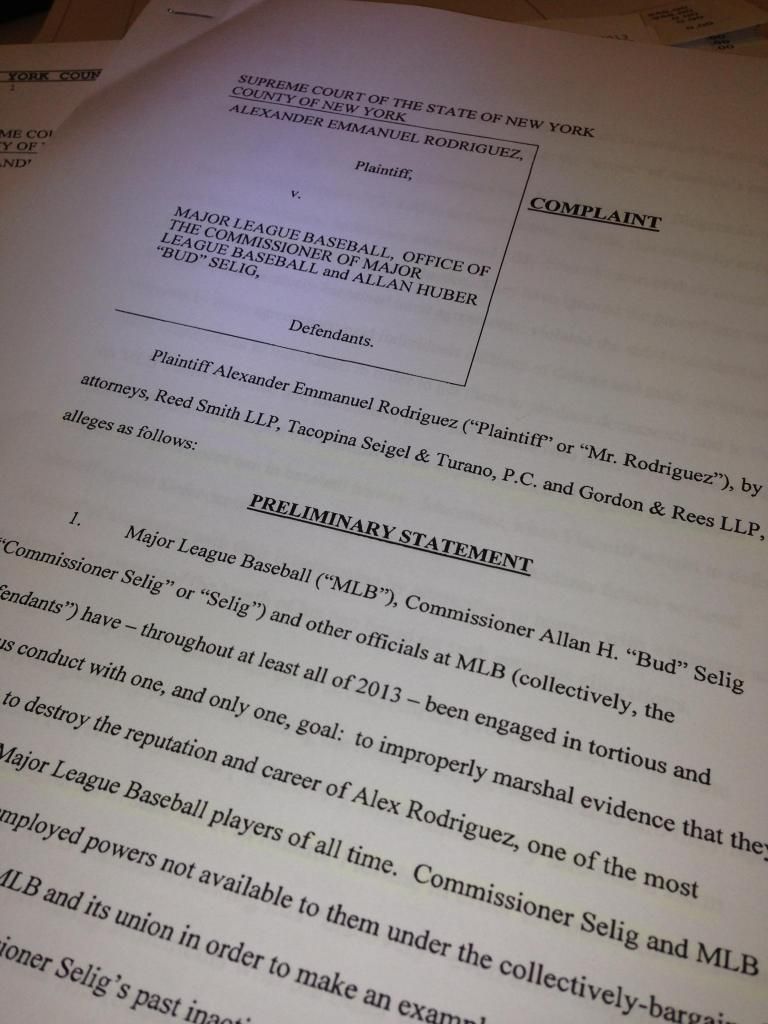
The complaint initially focuses on the alleged “vigilante justice” in MLB’s investigation of the Biogenesis clinic, calling the investigation a “witch hunt” and singling out Rodriguez for “an unprecedented 211-game suspension, the longest non-permanent ban in baseball history.” It is further claimed that Selig even appeared on the David Letterman show three weeks before Rodriguez’s suspension was officially announced to discuss the investigation and the financial consequences of the punishment, which will exceed $100 million, in Selig’s estimation.
Rodriguez’s baseball acumen is highlighted, portraying him as “one of the most accomplished baseball players of all time,” including having been the youngest player to surpass the 500 and 600 home run barriers, breaking the records set by Jimmie Foxx and Babe Ruth, respectively. Off the field, he details a $3.9 million donation to the University of Miami
Bud Selig’s tenure as commissioner is depicted as “disastrous” and the Mitchell report is evoked to highlight an allegation that Selig “deliberately turned a blind eye to prolific steroid use because of the overwhelmingly positive publicity generated by the record-breaking competitions of [Mark] McGwire, [Sammy] Sosa and [Barry] Bonds.”
Rodriguez seeks compensatory and punitive damages from the defendants claiming that their misconduct has interfered with actual and prospective contractual relationships with third parties, including the New York Yankees.
The Current Collective Bargaining Agreement
In 1968, the Major League Baseball Players Association (MLBPA), led by Marvin Miller, entered into its first collective bargaining agreement (CBA) with Major League Baseball, governing the terms and conditions of employment as an MLB player. The CBA is periodically negotiated and the current agreement is set to expire on December 1, 2016 .
Additionally, the MLBPA entered into a Joint Drug Prevention and Treatment Program with MLB, seeking to deter the use of banned substances, including anabolic steroids and other performance enhancing drugs and to "provide for...an orderly, systematic, and cooperative resolution of any disputes that may arise concerning the existence, interpretation, or application" of the policy itself.
After the Mitchell report was published, the Joint Drug Agreement was amended to allow for a more rigorous system of testing and punishment. This past January, the Joint Drug Agreement was amended again to allow for in-season testing. Not surprisingly, the Joint Drug Agreement contains confidentiality provisions regarding player information.
Biogenesis
In January 2013, the Miami New Times, published documents allegedly obtained from Biogenesis, an anti-aging clinic located in Coral Gables , Florida
Rodriguez, who makes his home in Florida , was allegedly linked to the Biogenesis Clinic in these documents. It is Rodriguez’s allegation that the true purpose for the Biogenesis Suit was to allow MLB to circumvent the agreed procedures and obtain “evidence” to “allow MLB to publicly shame and ultimately suspend Mr. Rodriguez and other ballplayers.”
It is further alleged that MLB issued a notices to Rodriguez’s former attorneys and public relations firm, seeking documents concerning their representation of Mr. Rodriguez and that these were undertaken “solely with the intent of harming Mr. Rodriguez and interfering with his business relationships.”
The complaint alleges that several individuals connected with the Biogenesis clinic were harassed by MLB’s investigators, offered money for their cooperation and even that the MLB “is paying [Anthony] Bosch a total of $5 million (in monthly installments) in order to buy his cooperation.”
What Is Alleged in the Lawsuit?
Rodriguez alleges that Major League Baseball officials “tortiously and maliciously” made statements and leaked information in order to damage A-Rod’s public reputation and prevent him from performing under his contract with the Yankees. It is further alleged that this was done to impugn Rodriguez’s public opinion and to bolster “Selig’s goal of cementing his legacy as the commissioner who cleaned up baseball.” Rodriguez’s 211-game suspension was officially announced on August 5, 2013 .
Rodriguez claims that the MLB’s conduct in failing to keep the investigation matters private has permanently harmed his reputation and ability to secure and retain endorsement contacts. For instance, he claims that Nike and Toyota terminated their deals with him and that his voice-over work on the animated film “Henry and Me” was cut. Additionally, he claims that the suspension would cause him to lose “tens of millions of dollars in salary.”
Rodriguez brings causes of action under tortuous interference with existing contracts and tortuous interference with prospective business relationships and seeks compensatory and punitive damages to be determined at trial.
What Comes Next?
The defendants will either answer, file motions to dismiss or seek removal to federal court based on diversity jurisdiction.
Updates will be posted as the case progresses, so check back often.

