Tuesday, October 15, 2013

Former Cardinals Slugger Albert Pujols Sues Former Cardinals Slugger Jack Clark for On-Air Accusations of PED Use

Jose Alberto Pujols Alcantara v. Jack Anthony Clark
St. Louis County Circuit Court, 13SL-CC03506

What Happened?

On August, 2, 2013, former Major League star Jack Clark accused Albert Pujols of having used performance enhancing drugs earlier in his career.  Clark alleged that he was informed back in 2000 by Pujols’ former trainer that he had "shot (Pujols) up" with steroids.  The show’s co-host also said he long had suspected that Pujols has used steroids to which Clark allegedly responded, "I know for a fact he was."

Albert Pujols, has maintained all along that he has never used performance enhancing substances of any kind.  In response to the broadcast, the radio station issued a retraction and apology to Pujols:

InsideSTL Enterprises publicly retracts the allegations of PED use by Albert Pujols made on the station recently.  We regret that these statements were made.  To the extent that our transmission and broadcast of these statements was perceived by anyone as indicating support for, or validation of, those allegations, we emphasize that we had no advance knowledge of the allegations, we did not make them, we know of no proof or evidence to substantiate them, and we disavow and retract them.
We believe that Albert Pujols is a man of principle, faith, and character.  We sincerely apologize to Albert Pujols, and his wife and family, for any damage this situation may have caused them, and we assure them that insideSTL has tremendous respect for the person he is, both on and off the field.
Additionally, the radio show was pulled from the air after only 7 broadcasts.
Despite the apology, Pujols has now filed a lawsuit against Clark, individually, seeking unspecified damages for defamation of character.  He claims that Clark’s, statements were "malicious, reckless and outrageous falsehoods" and have caused him “personal humiliation, mental anguish and anxiety.” 

Pujols further characterizes his own reputation as "impeccable and beyond reproach" and portrays Clark as a "struggling radio talk show host."  

Lie Detector Test

Via his attorneys, Clark has offered to take a lie detector test if Pujols will sit for one as well.


What’s Next?

Updates will be posted as new information emerges.

Friday, October 4, 2013

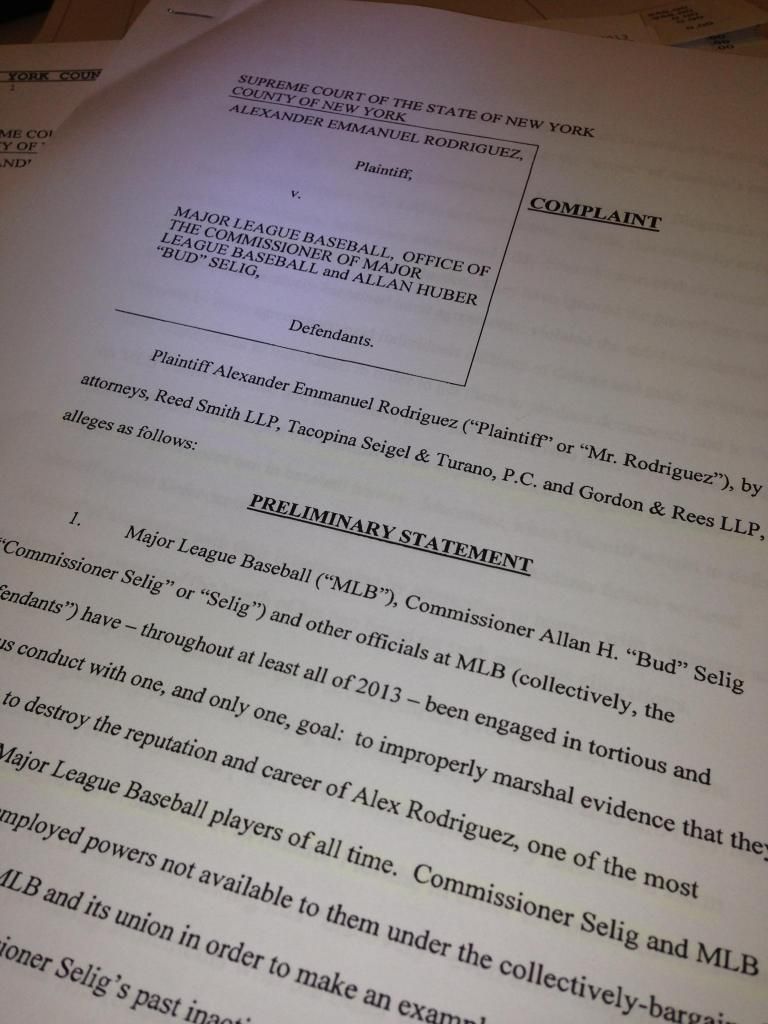
A-Rod Sues Major League Baseball and Bud Selig Over PED Suspension

Alexander Rodriguez v. Major League Baseball, et al.
Supreme Court of the State of New York, County of New York, No. 0653436 (2013)

What Happened?

Beleaguered superstar Alex Rodriguez has filed a lawsuit in New York state court against Major League Baseball, the Office of the Commissioner of Baseball and Bud Selig, individually, alleging tortious conduct with “one, and only one, goal: to improperly marshal evidence that they hope to use to destroy the reputation and career of Alex Rodriguez, one of the most accomplished Major League Baseball players of all time…the ‘savior’ of America’s pastime.”

The complaint initially focuses on the alleged “vigilante justice” in MLB’s investigation of the Biogenesis clinic, calling the investigation a “witch hunt” and singling out Rodriguez for “an unprecedented 211-game suspension, the longest non-permanent ban in baseball history.”  It is further claimed that Selig even appeared on the David Letterman show three weeks before Rodriguez’s suspension was officially announced to discuss the investigation and the financial consequences of the punishment, which will exceed $100 million, in Selig’s estimation.

Rodriguez’s baseball acumen is highlighted, portraying him as “one of the most accomplished baseball players of all time,” including having been the youngest player to surpass the 500 and 600 home run barriers, breaking the records set by Jimmie Foxx and Babe Ruth, respectively.  Off the field, he details a $3.9 million donation to the University of Miami to renovate its baseball stadium. 

Bud Selig’s tenure as commissioner is depicted as “disastrous” and the Mitchell report is evoked to highlight an allegation that Selig “deliberately turned a blind eye to prolific steroid use because of the overwhelmingly positive publicity generated by the record-breaking competitions of [Mark] McGwire, [Sammy] Sosa and [Barry] Bonds.”

Rodriguez seeks compensatory and punitive damages from the defendants claiming that their misconduct has interfered with actual and prospective contractual relationships with third parties, including the New York Yankees.

The Current Collective Bargaining Agreement

In 1968, the Major League Baseball Players Association (MLBPA), led by Marvin Miller, entered into its first collective bargaining agreement (CBA) with Major League Baseball, governing the terms and conditions of employment as an MLB player.  The CBA is periodically negotiated and the current agreement is set to expire on December 1, 2016.

Additionally, the MLBPA entered into a Joint Drug Prevention and Treatment Program with MLB, seeking to deter the use of banned substances, including anabolic steroids and other performance enhancing drugs and to "provide for...an orderly, systematic, and cooperative resolution of any disputes that may arise concerning the existence, interpretation, or application" of the policy itself. 

After the Mitchell report was published, the Joint Drug Agreement was amended to allow for a more rigorous system of testing and punishment.  This past January, the Joint Drug Agreement was amended again to allow for in-season testing.  Not surprisingly, the Joint Drug Agreement contains confidentiality provisions regarding player information.

Biogenesis

In January 2013, the Miami New Times, published documents allegedly obtained from Biogenesis, an anti-aging clinic located in Coral Gables, Florida that purportedly identified a number of Major League players who used the clinic to obtain human growth hormone and other performance enhancing drugs.  MLB thereafter sued Biogenesis, owner Anthony Bosch and others in Miami-Dade County Circuit Court. 

Rodriguez, who makes his home in Florida, was allegedly linked to the Biogenesis Clinic in these documents.  It is Rodriguez’s allegation that the true purpose for the Biogenesis Suit was to allow MLB to circumvent the agreed procedures and obtain “evidence” to “allow MLB to publicly shame and ultimately suspend Mr. Rodriguez and other ballplayers.”

It is further alleged that MLB issued a notices to Rodriguez’s former attorneys and public relations firm, seeking documents concerning their representation of Mr. Rodriguez and that these were undertaken “solely with the intent of harming Mr. Rodriguez and interfering with his business relationships.” 

The complaint alleges that several individuals connected with the Biogenesis clinic were harassed by MLB’s investigators, offered money for their cooperation and even that the MLB “is paying [Anthony] Bosch a total of  $5 million (in monthly installments) in order to buy his cooperation.”

What Is Alleged in the Lawsuit?

Rodriguez alleges that Major League Baseball officials “tortiously and maliciously” made statements and leaked information in order to damage A-Rod’s public reputation and prevent him from performing under his contract with the Yankees.  It is further alleged that this was done to impugn Rodriguez’s public opinion and to bolster “Selig’s goal of cementing his legacy as the commissioner who cleaned up baseball.”  Rodriguez’s 211-game suspension was officially announced on August 5, 2013.
 
Rodriguez claims that the MLB’s conduct in failing to keep the investigation matters private has permanently harmed his reputation and ability to secure and retain endorsement contacts.  For instance, he claims that Nike and Toyota terminated their deals with him and that his voice-over work on the animated film “Henry and Me” was cut.  Additionally, he claims that the suspension would cause him to lose “tens of millions of dollars in salary.” 

Rodriguez brings causes of action under tortuous interference with existing contracts and tortuous interference with prospective business relationships and seeks compensatory and punitive damages to be determined at trial.

What Comes Next?

The defendants will either answer, file motions to dismiss or seek removal to federal court based on diversity jurisdiction. 

Updates will be posted as the case progresses, so check back often.


Tuesday, September 24, 2013

Fan Sues Phillies After He is Hit in the Face By a Foul Ball He Tried to Catch Barehanded

Pakett v. The Phillies, LP, 871 A.2d 304 (Pa.Commw. Ct., 2005)

What Happened?

Plaintiff Neil Pakett, a dentist, attended the Philadelphia Phillies game at Veterans Stadium on June 25, 2001.  He was sitting in Section 232, Row 5, Seat 8 when Jimmy Rollins came to bat from the left side of the plate in the bottom of the first inning.  Rollins fouled off a pitch into Section 232. 

Dr. Pakett saw the ball coming towards him and attempted to catch it with his bare hands because he “wanted a souvenir.”  Unfortunately, Dr. Pakett was not able to catch the ball and it struck him in his left eye.  As a result, he experienced temporary blindness and underwent surgery.  He claimed that his full vision never returned.

Dr. Pakett was familiar with Section 232, having occupied the same seat 6 or 7 times over the span of several years.   Additionally, he was aware that foul balls were hit into the immediate vicinity of his seat 4 or 5 times per game.  This particular seat was about 80 feet from home plate, to the left of a plexiglass shield that had been installed in 1996 to better protect the fans behind the batter from foul balls.

Dr. Pakett conceded that a batted ball entering the stands could cause an injury and acknowledged that the back of the ticket contained a warning that he entered the stadium at his own risk. 

The Phillies and the City of Philadelphia moved for summary judgment, asking the court to dismiss the lawsuit because there was no duty on their part to protect him from or warn him of the risk of being struck by a foul ball.  The court agreed and found that Dr. Pakett’s having been hit by the foul ball was an “inherent risk” of the game of baseball and that there were no issues with the backstop in place at Veterans Stadium at the time of the occurrence.   Finally, the court found that Dr. Pakett had “sufficient reaction time” to get out of the way of the ball but, rather, he intentionally tried to catch the ball to take home as a souvenir.  

Plaintiff appealed the ruling claiming that there was a duty to protect the area of the stands where plaintiff was sitting due to the occurrence of foul balls landing in that area with “great frequency, speed and force.”

Who won?

The Phillies and City of Philadelphia.  The court affirmed the trial court’s granting of summary judgment.

Why?

The chance to catch a foul and keep the ball is “one of the exciting thrills of attendance at the game.”   The “no-duty” rule was found to apply because the risk of being hit by the foul ball was a common and inherent risk of attending a baseball game and plaintiff assumed this risk by attending the game. 

Here, Dr. Pakett was struck by the foul ball during the course of the game while sitting in a seat he had occupied on other occasions.  He was well aware that foul balls frequently entered his section and as the particular ball came towards him, Dr. Pakett attempted to catch it instead of trying to avoid the ball.

Further, plaintiff introduced no evidence that the netting and plexigass protection behind home plate was inadequate or deviated from an established standard for Major League ballparks.      

Orioles Pitcher Intentionally Throws Ball at Fan Causing Injuries at Fenway Park

Manning v. Grimsley, 643 F.2d 20 (C.A.1 (Mass.), 1981)

What Happened?

The Baltimore Orioles and Boston Red Sox game at Fenway Park on September 16, 1975 featured a marquee match up between aces Jim Palmer and Luis Tiant.  Both pitchers would toss complete games, with Tiant shutting out the Orioles 2-0.

During the first three innings of the game, Orioles lefty Ross Grimsley was warming up in the visitor’s bullpen next to the right field bleachers.  He was being “continuously heckled” by the fans sitting in the nearby section and he stared the hecklers down on several occasions.  At the end of the third inning, as the bullpen catcher made his way back to the bench Grimsley threw a ball directly towards the hecklers at “more than 80 miles per hour.” 

The bullpen was separated from the stands by a wire mesh fence; however, the ball passed through the fence and struck David Manning (17) in the face.  Manning was admitted to the Massachusetts Eye and Ear Infirmary where he had both of his eyes patched and he experienced some swelling to the left side of his face.  It was unclear whether he sustained any permanent injuries, however.  Grimsley replied that he was just warming up and did not mean to hit him.  He was “sorry as heck the whole thing happened.”

Manning filed suit against Grimsley and the Orioles for battery and negligence.   The case proceeded to trial and at the close of plaintiff’s case, the court granted defendants’ motion for a directed verdict, meaning that plaintiff had not carried his burden of proof and was unable to prove the elements necessary to establish that a battery had occurred.  The negligence count survived; however, the jury subsequently found in favor of Grimsley and the Orioles.  Manning recovered nothing.

Plaintiff appealed the court’s ruling on the battery count.

Who won?

Manning won the appeal on the battery count and was granted a new trial.  He did not appeal the jury’s verdict as to the negligence count.

Why?

In order to prove battery, Manning had to show that (1) Grimsley intended to harm him and (2) the harmful contact with him resulted directly or indirectly from Grimsley’s conduct.  Testimony from witnesses included eyewitness observations that Grimsley looked into the stands immediately following the heckling on several occasions and that “he had an angry, frustrated look on his face, as though he were releasing tension” at the moment he threw the ball towards the fans. 

The court found that in light of Grimsley’s status as an expert pitcher, the testimony regarding his actions in response to the heckling and the fact that “the ball traveled at a right angle to the direction in which he had been pitching and in the direction of the hecklers” that the jury reasonably could have determined that Grimsley intended (1) to throw the ball at the hecklers (2) to cause them imminent apprehension of being hit and (3) to respond to conduct presently affecting his ability to prepare to enter the game.  Accordingly, it was error for the district court to have directed a verdict in favor of Grimsley on the battery count.

Then what happened?

There is no further record regarding what happened upon rehearing.

Ross Grimsley went on to win 124 games, including 20 in 1978 with the Montreal Expos.

Friday, September 6, 2013

Merkle’s Boner and False Imprisonment


The Polo Grounds viewed from "Coogan's Bluff"
Talcott v. National Exhibition Co., 144 A.D. 337, 128 N.Y.S. 1059 (2 Dept., 1911)

What Was Merkle’s Boner?

On September 23, 1908 the Chicago Cubs played the New York Giants at the famed Polo Grounds.  Al Bridwell came to bat with two outs and the game tied 1-1 in the bottom of the ninth.  He laced a single to the outfield and the runner on third trotted home, thinking he had just scored the winning run.  The Cubs second baseman Johnny Evers, of the famed “Tinkers to Evers to Chance” double play combination and future Hall of Fame inductee; however, called for the ball from the outfield because Fred Merkle, the Giants runner on first, had not touched second base.  Although there is controversy regarding whether Evers got the actual ball back, the umpire ruled Merkle out at second and due to the force, the apparent winning run was erased.

As was common at the time, the fans at the Polo Grounds would walk across the field after the game to exit the ballpark.  By the time the play was decided and the winning run nullified, however, the fans believing the Giants had won were already streaming across the field and it was impossible to resume the game before the game was called on account of darkness. 
On October 6, 1908, the National League Board of Directors made its final ruling that because Merkle had failed to reach second, the force rule was applied correctly and the game was a tie.  At the end of the season, the Cubs and Giants were tied for first place and a makeup game was needed to determine which team would play in the World Series.  This game was played on October 8, 1908 at the Polo Grounds and reportedly drew 40,000 people, the largest crowd ever to have attended a single baseball game at the time.

The Cubs won this game over the Giants and went on to beat the Tigers 4-1 in the World Series, their last World Series victory.  The play was dubbed “Merkle’s Boner” and Fred Merkle was nicknamed “Bonehead.”  Years later, Merkle admitted that he never touched second but claimed he had been assured by umpire Bob Emslie that the Giants had won. Despite a solid 16-year Major League career, including four seasons with the Cubs, Merkle was never able to shake the stigma of the play. 

What happened?

As a result of the play and the October 6th mandate for the makeup game, the Polo Grounds played host to the makeup game on October 8, 1908.  This game was “of very great importance to those interested in such games, and a vast outpouring of people were attracted to it.”  On the morning of the game, the ticket booths at the Polo Grounds were overwhelmed with people trying to secure reserved seats for that afternoon’s game.    

Plaintiff Fredrick Talcott, Jr. went to the ballpark intending to buy tickets and entered an “inclosure” where the ticket booths were located.  After finding that the tickets were sold out, he tried to leave the inclosure along with a great number of people also trying to exit at the same time.  As he attempted to leave, however, ballpark attendants prevented his exit and he was “detained in the inclosure for an hour or more, much to his annoyance and personal inconvenience” and brought this lawsuit seeking damages for false imprisonment.  He further claimed to have been pushed by the defendant’s “special policemen.” 

The Giants countered that plaintiff simply could have used one of the other exits available.  Mr. Talcott alleged, however, that he was not aware of any other exits to the inclosure and none were pointed out to him.

Who won?

Fredrick Talcott.  The case went to a jury trial and Mr. Talcott was awarded $500 in damages (approximately $12,000 today) and judgment was entered on May 19, 1910.  The Giants appealed and the appellate court affirmed the judgment in favor of Mr. Talcott.

Why?

The jury found that that plaintiff’s detention was unwarranted and awarded him $500.  The court agreed with this finding, ruled that the award was not excessive and found no reason to interfere with the jury’s verdict. 

Additionally, the court found that Mr. Talcott was not required to demonstrate that he incurred any special or actual damages as a result of the detention.            

Thursday, September 5, 2013

Missouri Ballplayer Jailed for Playing Baseball on Sunday

Ex parte Neet, 157 Mo. 527, 57 S.W. 1025 (Mo. 1900)

What were the issues?

Is it unlawful to play baseball on Sunday in Missouri? Is habeas corpus available to someone convicted of playing baseball on Sunday?

What happened?

John Neet was convicted of a crime for playing baseball on June 4, 1899, a Sunday, and sought to appeal his conviction.  At that time, Missouri statute §2242 proscribed several activities on Sundays as follows: “Every person who shall be convicted of horse racing, cock fighting or playing at cards or games of any kind, on the first day of the week, commonly called Sunday, shall be deemed guilty of a misdemeanor, and fined not exceeding fifty dollars.” 

The Kansas City court of appeals in State v. Williams, 35 Mo. App. 541, had previously interpreted the statute to specifically prohibit the playing of baseball on Sundays even though baseball was not mentioned explicitly in the section.  This was because the “games of any kind” was construed to include baseball and the statute was “evidently intended to prevent the desecration of the Sabbath, by restraining the doing of those things which are offensive to a Christian community by being done on that day.”

Meanwhile, the St. Louis court of appeals in Association v. Delano, 37 Mo. App. 284, took the position that the “games of any kind” was intended to limit games of chance or of an “immoral tendency.”  The court found that athletic games and sports “which tend to the physical development of the youth” are to be encouraged.

Who won?

John Neet.  The court found that he was imprisoned for an activity that was not unlawful and the writ of habeas corpus was granted, giving Mr. Neet his release from custody.

Why?

The court traced the origins of the statue under which Mr. Neet had been convicted and found that it was originally enacted in 1835, before baseball had been invented.  Further, baseball was found to be a “game of science, of physical skill, of trained endurance, and of natural adaptability to athletic skill."  The court also, in an interestingly shortsighted passage, declared that baseball “is not a gambling game, nor productive of immorality.”

Ultimately, the court held that if the “games of any kind” provision of the statue was to be liberally construed, as in Williams, it might cover every game that had been or might be invented.  They felt it was the legislature’s job to expressly limit the playing of baseball on Sundays, if they were so inclined. 

Wednesday, September 4, 2013

Chicago Cubs Sue Mark Guthrie to Recover on Payroll Error

Chicago National League Ballclub, Inc. v. Guthrie
Middlesex County, Connecticut, MMX-CV04-0104650-S

What happened?

Mark Guthrie was a big lefty reliever who pitched for 8 teams over the course of his 15-year Major League career, which included a World Series victory with the Minnesota Twins in 1991. He played for the Chicago Cubs from 1999 to 2000 and again in 2003. His salary in 2003, which was his last in the Majors, was $1.6 million.

A man with the same name, Mark Guthrie, delivered newspapers for The Courant newspaper in the tiny Connecticut town of Old Saybrook. He presumably made much less than the Cubs’ Guthrie.

The Tribune Company, based in Chicago, Illinois owned both the Chicago Cubs and The Courant newspaper at the time. Due to a mix-up, someone from the Tribune deposited over $300,000 into the wrong Mark Guthrie’s bank account. Suddenly, Connecticut’s Mark Guthrie was flush with cash.

Mr. Guthrie realized that he was paid in error and contacted the Tribune to straighten out the mix-up. He eventually returned all but $26,000, seeking assurances that he would not be liable for taxes on the mistaken payroll deposit into his account.

After Mr. Guthrie froze his account, however, the Chicago Cubs filed this lawsuit in an attempt to recover the amount that had been held back.

Who won?

A settlement was reached and the case was dismissed in January, 2005. The Cubs had filed a motion for summary judgment that was not heard. Mr. Guthrie was satisfied that the IRS would not have any issues with the sudden influx of cash to his account.